Monday, March 05, 2007

More Drakes pix

Here us the waterfall that was the object of all of that riding. The pictures don't do it justice. The pools in the river had small fish that looked like trout, but our guide had some different name for them.

And Cowboy Richard led the way down the hill back to the harbor, only suffering moderately after 4 hours in the saddle.

Then, this very same night we did another flamenco show. We are getting good at performing with no rehearsal and no practice. Fun.
We really liked Drakes Bay. The rainforest was amazing...and a bit humid, of course. So tonight, we are leaving for Golfito to reprovision before leaving for Panama.

Drakes Bay

At Drakes Bay, we took the dinghy up a river in the rainforest.
The next day, we took a horseback trip up to a waterfall. Here is cowboy Richard


Andi had this view of the rainforest over the top of her horse. We rode in the river at times, but the horses were surefooted.

Finally we had to park the horses and go the last little bit on foot. The blog only allows 5 pictures per story so I'll start another one.

Bahia Uvita pix

Before leaving for Drakes Bay, we stayed at Bahia Uvita, the source of the mosquitos. Here is Andi on the sand spit that only exists at low tide and Saeta anchored in the bay. As soon as we got back to the boat we found all the mosquitos described below.

Saturday, March 03, 2007

The attack of the mosquitos

Mar. 3, 2007 Drakes Bay, Costa Rica
Yesterday while anchored at Bahia Uvita, we rowed ashore to walk around. When we got back to the boat, we found that the outside of the hull was covered by thousands of baby mosquitos. Some were bigger than others, but they were smaller than the ones we catch trying to feed on us at night. It's too bad we didn't think to take some pictures of all of them because I've never seen anything like it. We freaked out! We found that by splashing buckets of water on the hull, we could dislodge them. But then they just flew onto something else although we drowned some of them. Once we got the hull sort of cleaned off, we decided that we wanted to be somewhere far from mosquitos, so we pulled up the anchor and departed at once for Drakes Bay. We assumed that the wind of sailing would blow all of the little bugs away. I figure that there were 10,000 of them in the beginning.
We don't know why they chose our boat in the first place. We were anchored 300 yards offshore but maybe an offshore wind blew them out to us and our boat was the only island in sight so they picked it. We've had birds land on the boat when they got tired of flying and needed an island (but I digress).
Well, the sailing might have gotten rid of some of them, but there were several hundred still with us when we got to Drakes Bay (5 hours). We again threw water on them and swatted with a flyswatter those who got inside. Andrea was the relentless killer (Albert Schweitzer she wasn't).
By dinner time, we began to realize that truly drastic measures would be needed if we wanted any sleep and wanted to awake without needing transfusions. So we set up the table in the cockpit, made a pitcher of drinks, and set out dinner so that we could stay outside for a while. Then we closed up the boat and lit a bunch of mosquito coils. Folks in the tropics know what those are. With the boat closed up, it got smokier and smokier and finally there were no bugs buzzing around the lights. By this time, dinner and drinks were done and we opened up the boat and put Andrea's custom bug screens over all the windows. She made these before we left, not fully appreciating how valuable they would be. After airing out the boat, there was not a single bug to be found and we spent the night absolutely uneaten. Given that we started with 10,000 mosquitos (give or take a few), it is remarkable that neither of us have a single bite!
Once in a while, if we anchor too close to shore or if the wind is offshore, we get mosquitos. But it is not all that common, especially since we left Mexico which has marinas built in swamps. No-see-ums are much worse as they raise an itchy welt that can last for a week.

----------
radio email processed by SailMail
for information see:

http://www.sailmail.com

Thursday, March 01, 2007

In the jungle

March 1, 2007 Thursday
It turns out that we had a very successful flamenco performance while we were at Bahia Ballena. The French couple on the next boat had children in the luxury hotel business and they set us up with a show on short notice. It went surprisingly well. We totally winged it. Neither of us bothered to practice at all and so we just got up and had fun.... just the way I like it. Andrea was happy, too. I think she is awesome when she just lets herself dance without thinking about choreography and routines. And my guitar playing seems to have jumped up to a new plateau. Not bad for no practice.
Then we started moving South. We visited Isla Cedros further into the Gulf of Nicoya just to see how it was. It is the dry season in Costa Rica and things get kinda brown. Cedros was OK, but we started thinking about Panama and getting ourselves scheduled for the canal, so after a day at Cedros, we sailed to Bahia Leona on the other side of the Gulf. It was only about 15 miles and we got to sail fast the whole way across. Wonderful. Bahia Leona had a luxury hotel there which reportedly welcomed cruisers, so long as they spent some money in the restaurant or bar. Well, those were the good old days. Now, they want $20/person for a day pass - then you get to spend money in the bar. But it was a really nice hotel with lots of wildlife around. We saw some macaws that must have been 3 feet long!
This morning, we got up at 2AM and caught the ebb tide to get a boost as we left the Gulf of Nicoya. 71 miles later, we are anchored at Bahia Uvita, our first real jungle anchorage. The jungle begins just below Bahia Leona and will continue all the way through Panama. It is much greener and very lush. Unfortunately, the humidity is very high and there are some big thunder clouds forming above the peaks just in from the shore. We say lightning last night, very far away. But tonight, we might see some a lot closer. Lightning is one of the cruiser's worst nightmares, because if lightning strikes the boat, there is a very good probability that it will wipe out all the electronic devices aboard. The cost of that is staggering - one of the main reasons why I pay for insurance.
Early this morning before it was too hot, Andi cooked up some new recipe that she got from a Costa Rican book. You would be amazed at how well we eat on this trip. Yesterday she made chicken mole with a chicken we bought at a little local market. 20 minutes in a pressure cooker and it was falling off the bones. Yum. The only thing we are missing is really good wine. We've gone through our stocks and now we are having to drink what is in the stores. They have some good wines, but very pricey.
In a few days, we will be in Golfito, where we are going to stay for a while and travel inland. There are marinas there and we are looking forward to not being on the anchor for a while. We haven't been in a marina with docks since Barra de Navidad, Mexico. They are expensive here, but I'm looking forward to plugging in and running the air conditioner. We have fans everywhere, but not the same.
Don't forget to write. Pictures later when we have internet.

Saturday, February 24, 2007

Some more pictures

Here is the princess, wearing her safety harness and a swimming suit, steering us up the Gulf of Nicoya. And at the right is a bird that landed near us. These are common.


At Bahia Ballena, we did a flamenco show.

Gulf of Nicoya

Feb. 24, 2007 Saturday
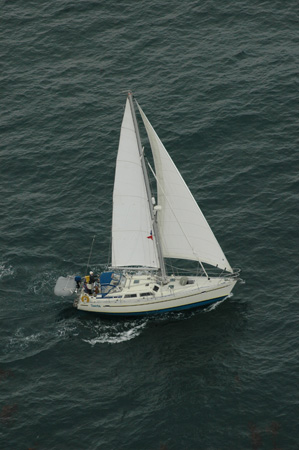
At left is a picture of Saeta taken at the start of the Baha-haha that we downloaded from the "Latitude 38" website.


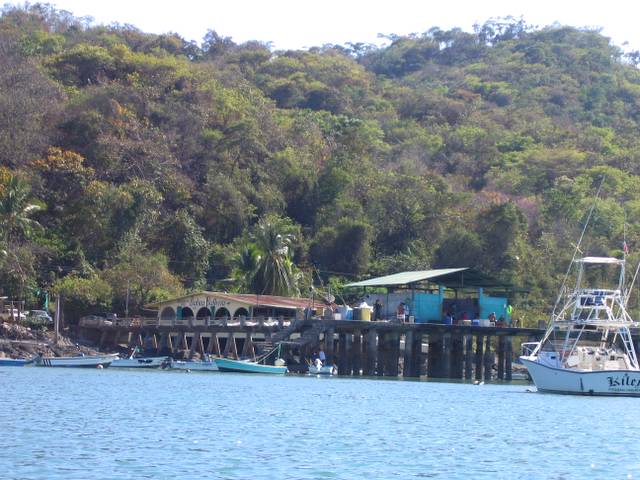
Here we are at Bahia Ballena (Whale Bay) in the Gulf of Nicoya.These pictures show the Yacht Club and the fishing dock in front of it. The Yacht Club has the arches and yellow walls. There seem to be a lot of ex-patriates sitting around in there drinking all day. English is the standard language. But the meals are cheap and good. We had a mahi-mahi dinner and cocktails for $19.00 for both of us.
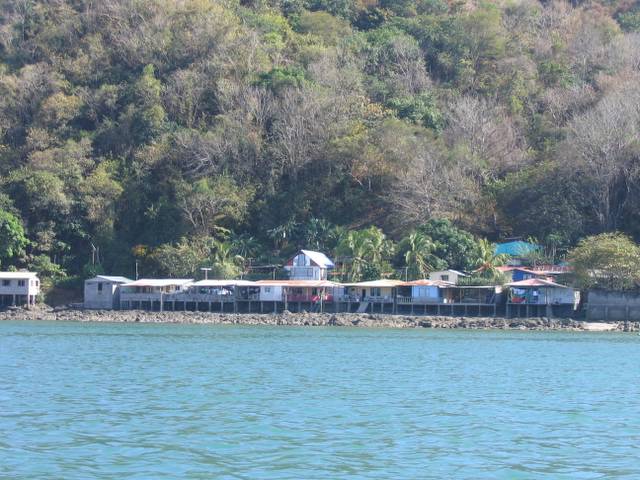
The row of tin-roofed houses are where the fishermen and their families live.


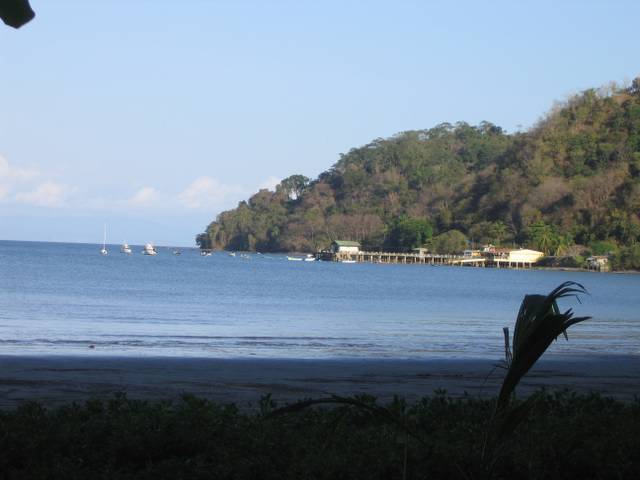
This picture is taken from the beach across the bay while we were walking to the market. We are one of the sailboats off the end of the fishing pier.

Howler monkeys are heard at sunrise and sunset. Since there are no pinnipeds down here (seals and sea lions), these monkeys make us feel right at home. They sound just like the sea lions under the Santa Cruz pier.
In the next few days we are going to move on further into the Gulf to visit some of the islands before heading down the South Coast to Golfito. The winds have finally moderated and we are looking forward to some relaxing time. We met a French couple on the neighboring boat who are coming over tonight for cocktails. They have contacts that may result in a performing opportunity for us.

Sunday, February 18, 2007

On the road again....rambling thoughts

Feb. 18, 2007 - Sunday
We are moving South again after a two week delay in Playa del Coco. We were waiting for parts for our genset, a crucial piece of equipment. You see, a modern boat like this one uses lots of electricity. All the radar, GPS, and electronic navigation tools that make so much easier than it was when I started sailing, all use 12V electricity. And of course, the two refrigerators and freezer that provide frozen tuna steaks and ice cubes - those eat lots of electricity. So the genset is very important. It passed through a lot of engine cooling issues and ultimately could only be fixed by getting a new impeller for a water pump. It took forever to arrive, but at last it's here! We are 100% again.
We used to charge our batteries and get electricity by plugging into shore power at the dock. But we haven't seen a dock since Barra de Navidad, about 2 months ago. We are living on the anchor and so must make our own power. We can do that in a pinch by running the big engine, but diesels don't like being run under a light load and besides, the big engine burns a lot of fuel. So we are very happy to have the genset running and drinking about an eighth of a gallon per hour.
So having charged the batteries, we pulled up the anchor this morning and sailed down to Bahia Potrero, just a short trip. We had a great sail with the wind constantly rising until it was close to 25 knots by the time we got in. We had light winds while we were waiting around Coco and now that we're ready to move, we have too much wind. But not so bad. 25 knots is only too much wind if it has a chance to blow for a while and raise big waves. In this case, it's blowing right off shore, so by sailing close to the beach, there are no waves. So we put up small sails and make a fast passage.
In a few days, we will be down to the Gulf of Nicoya and away from the Papagayo winds that we've been living in. There are lots of islands down there to explore and the jungles are said to be greener. It's the dry season here now and it's kinda brownish. There are howler monkeys in the trees though. We hear them every morning. They sound like lions or gorillas, not like little monkeys. I don't know how they do it.
Other news....I am slim again. You remember how I was looking like a python who ate a pig? Well, the pig is gone. I have the body that I had in college, thanks to regular exercise. There is some loose skin around the middle that shows once in a while. Hopefully it will tighten up. Andi is well and we're looking forward to your emails.

Friday, February 09, 2007

Still waiting around...

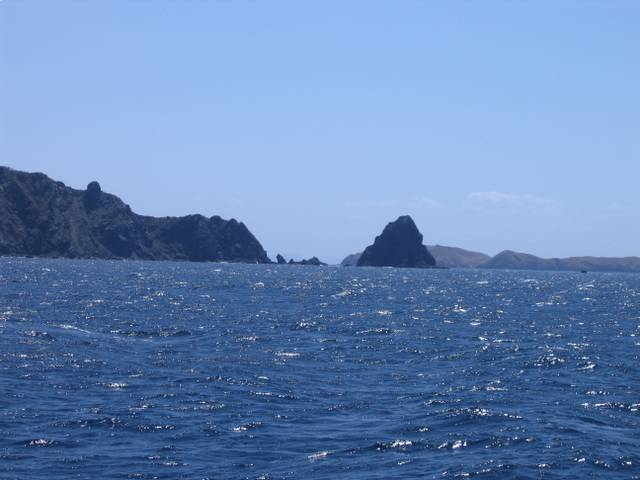
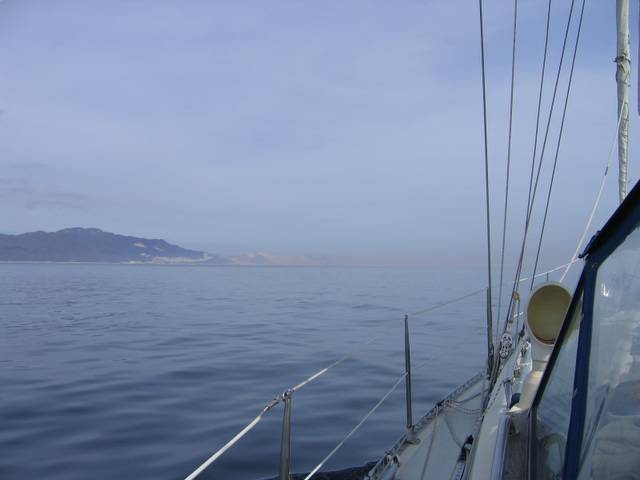
Here is the dreaded Cabo Santa Elena, on it´s best behavior. It didn´t act too bad.
We need parts for the genset, so we are waiting in the Playa del Coco area for another week until they get here. Except for the wind, it is very nice. Right now we are inland, having made a road trip to Liberia. Gotta go. Don´t forget to write.

Tuesday, February 06, 2007

Tired of wind

Feb. 6, 2007 Bahia del Coco, Costa Rica
We have been at Bahia del Coco for a few days now and we are getting very tired of the constant wind. We were weatherbound at Bahia Santa Elena and have been the same here. It blows 20 to 30 knots every day and with that much wind, we can't do very much. It just howls. But that's the Papagayo region. It's funny, all the way down the Mexican coast, we had almost no wind and had to motor all the time. Now we have lots of sailing wind, but we can hardly take the dinghy ashore. But we have got a lot of confidence in our anchoring gear now. It has been holding us very nicely.
We would have moved on by now, but had to work on our genset. Someone once said that cruising is fixing things in inconvenient locations. Well, our genset has been like that. It started leaking coolant which meant that I had to go into the engine room and add some fresh water to the cooling system every half hour. But at least it worked. Our genset keeps our batteries charged which provides us with the comforts of home - like ice cubes. Finally, I figured out that the genset had a metal plate on top of it that had suffered from it's bolts vibrating loose. When I tightened the bolts, the leak stopped. Whew. Then, the genset started overheating. It turns out that the impeller in the sea water pump that cools the engine had come apart and that we need to get a new impeller from the genset maker. Now that is something that can't be fixed overnight. We will have to get the new parts and then the problem will be solved. Until that time, we have to charge the batteries by running the big engine (which we can do, although it uses more fuel and isn't very good for the big engine).
So, we're going to start moving down the coast toward the Gulf of Nicoya and eventually Puntarenas, where we'll be able to collect the genset parts and get it working again. We can't believe how dependant we are on regular transfusions of electricity for our batteries. The genset does it so much better and quicker.
And one of the reasons for the genset is ice cubes. I have to confess to a major addiction - Pepsi-cola. It's amazing how satisfying it is to have a tall iced glass of Pepsi on a hot day. Back in the states, cola drinks were something that came with a burger. Here, it is a very special treat, but only if there is lots of ice. A hot cola drink is an abomination. So we are living the good life with ice cubes, hot showers, and time to read all the books we want. One of these days the wind will lighten up and we will move on. Maybe tomorrow we'll move on to Bahia Potrero. Stay tuned. Film at 11.

Saturday, February 03, 2007

Gulf of Papagayo

Feb. 3, 2007 - Saturday
We spent almost a week in Bahia Santa Elena with the wind howling through the anchorage. When a little weather window opened up for us to leave, we took it and never even had a chance to really see the sights of Bahia SE. There was a little stream that we could have gone up in the dinghy to see a waterfall, but, oh well...
When we got mellower weather we started out for Cabo Santa Elena, which has a bad reputation sort of like Point
Conception for being a place where the winds are extra strong and the waves are large. As we left the bay, the wind came up from behind us and we thought, "Oh no, it's already 25 knots. What will it be at the Point?" But strangely enough, as we reached the point the wind started to die and it was down to 10 knots as we went around. Since it was smooth,we headed directly for our destination, Bahia Huevos, and arrived there by 2PM. Bahia Huevos was a pretty little bay with the clearest water I've ever seen. We could see our anchor on the bottom out in from of the boat from our swim step at the back of the boat!
We spent the night at Bahia Huevos, but left the next morning because we wanted to officially check into Costa Rica and the port of entry was 6 miles away at Bahia del Coco. Since it was Friday, we needed to check in at once to avoid overtime charges on the weekend. Everything went smoothly enough at the check in. The hardest part was to find a functional copy machine. Bahia del Coco has all the pleasures of a harbor - bank, markets, internet cafe, and lots of restaurants. I even found some hardware that I had been searching for for a long time.
I think we'll stay here through the weekend at least. If we get to the internet cafe, maybe we can post some pictures. We have a lot of time available in Costa Rica since we are waiting for Andrea's daughter Elinore to join us on March 18. We got down here faster than we needed I suppose, but I'd rather go when the weather is good. We are now past the worst of it. The only other hurtle will be Punta Mala in Panama, but we are helped greatly in these difficult parts by the weather predictions available on the cruiser's nets (on the single-sideband radio). The Pan-Pacific Net has a guy named Don who was a weatherman before he retired. He comes on every morning and gives a complete weather summary for the entire region and then answers specific questions from individual boats. The Net gets you acquainted with a lot of other cruisers and after a while, they know who you are and where you are going. If you don't call in for a few days, they start to get worried about you. I kinda like that. Write if you get time.

Sunday, January 28, 2007

Welcome to Costa Rica

Jan. 29, 2007 Sunday
At daybreak this morning, we arrived in Bahia Santa Elena, our first port in Costa Rica after a strenuous non-stop sail from Barillas Marina - about 280 miles. How about this red sunrise? We made no stops in Nicaragua. It took us two full days and the last day and a half was in the infamous Papagayo winds - as high as 34 knots, but mostly in the low 20's. This is very different from the mellow Mexican sailing that we have seen for so long and, as a result of having relaxed our guard, we got some water down below because not all the hatches were closed tightly. We did get in a lot of sailing though, and once we learned to sail close to the beach, the waves were tolerable.
So we are resting up and drying out. It is still blowing like stink in this beautiful little bay. Bahia Santa Elena is almost completely landlocked with a small entrance leading into a large round bay. We had to time our arrival very carefully because we couldn't have gotten into here in the dark without relying totally on our electronic charts (which we hadn't yet been able to verify for accuracy). As a result, we spent much of last night trying to sail the boat 'slowly', not something we do often. We just crawled along in all kinds of wind so that we would arrive as the sun was rising. We timed it so well that we just had enough visibility when we arrived at the entrance. As it turned out, our electronic charts were spot on as well, so everything worked out nicely. It is a little dicey when you are running downwind with 30 knots of wind behind you, heading for a dark mass of land that reportedly has a gap in it somewhere, but if it doesn't, that dark mass of land could be very bumpy.
There were two other boats here when we arrived, but by the time we woke up, both had moved on so we have the place to ourselves. There is no development or human settlements here. The cruising guides speak of parrots and monkeys, but all we have seen so far is wind. Apparently this wind is going to last until Tuesday, we we'll just read and work on projects. It's not hot, so hooray.

Thursday, January 25, 2007

Meeting the monkeys

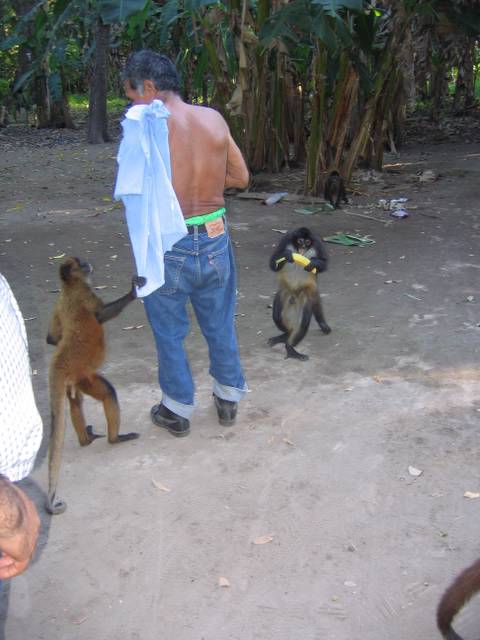
Here is the monkey caretaker. The monkeys know that he is hiding bananas under his shirt. This is Maria and Pancho.
Here are some of the monkeys that live in a nearby teak forest, under the care of a local family. The monkeys really don't need any care as there are bananas and fruits everywhere, but for some reason they have a connection with this family.
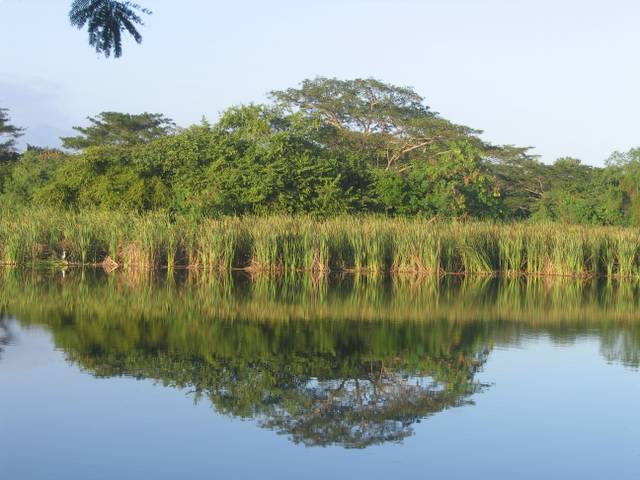
On the walk to the monkey forest, we passed by this fresh water estuary with sugar cane growing right down to it.
Here's another view of the estuary.


This is Pancho, the head monkey. He is the only male. The rest are females. He doesn't look too bad, considering.
The man behind me is the one who has domesticated this tribe. I got to feed bananas to them.

More pix of Copan Ruinas

Here is a view from the top of one of the larger pyramids across the main plaza. Copan was in its heyday (500 - 750AD) a very large city. It fell apart from an economic standpoint when it's population got bigger than the local agriculture could support.
Here is one of the smaller pyramids at Copan. There are quite a few and some much larger. The rockwork is most impressive. You can see one of the contemporary rulers on the top.
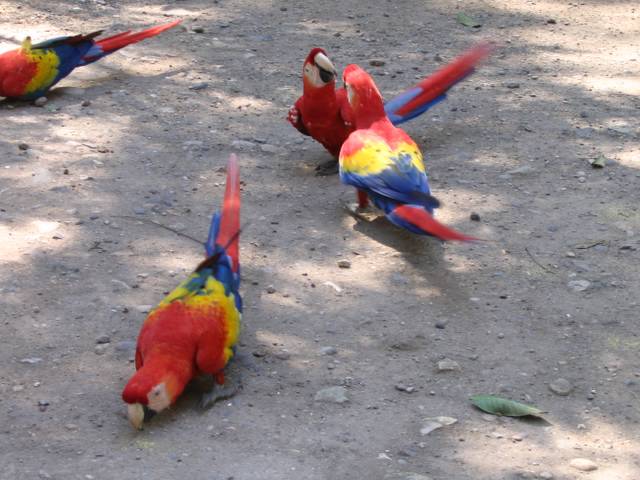
Here are some parrots that were hanging around in Copan, doubtless due to the parrot feeders that were hanging in the trees.
Here us a boy who has bought a chicken and is waiting for the bus so that he can take it home. The chicken was not pleased.

Some pictures

Here is a poor example of what I mean by a TREEscape. It just wasn't possible to catch a good picture out the window of the bus. But there are so many variations in the plant life.


Here is a street scene from Antigua, Guatemala. The whole town is like this, really classic colonial style.

Here are some examples of the native dress. They don't just do this as costumes for tourists - they dress like this every day.
This lady sold Andrea some weavings, which they do very well. However, the vendors are very skillful in their sales techniques. In some ways they reminded me of the gypsy flower vendors in Granada except that the indians are much more friendly and not so obviously trying to get your money. Because of that, they probably have more success.

Here is Lake Atitlan..or at least a small piece of it..and the town of Panajachel.

Impressions of Central America

Jan. 24, 2007 - Wednesday - We are back at Barillas Marina in El Salvador after a bus loop through Guatemala, Honduras, and El Salvador. If we had a decent internet connection, we'd like to put up a bunch of pictures, but we don't have even a reasonable connection so I am sending this by radio again because it works.
We were fascinated by the Central American landscape but even more by the TREEscape. Everywhere I have lived, there were about 5 species of trees around at any given time and usually one species was dominant. Here, I would say that there are about 40 species of trees and they are intermixed so that every time the bus came around a corner, there was a new landscape with rough volcanic overtones, but the variations in the trees projecting from the folded ground was amazing. There were evergreens mixed with bananas and coconut palms and then a variety of other trees with all different kinds of canopies, leaves, and flowers. I'll try to put up a picture later.
We passed through Antigua, Lake Atitlan, back to Antigua and then to the Mayan ruins at Copan. From there we went to San Juan Sula, which is a big and fast growing commercial city in Honduras that is a transportation hub. From here we were able to get a bus back to San Salvador and then back to the marina.
Last night, we went for a short walk to visit the local monkeys. The owner of the marina provides a small stipend for a family that lives in the middle of a teak forest. They have virtually domesticated an entire tribe of spider monkeys and enjoy showing off their tribe to the visitors. The monkeys were curious about us as we arrived and gathered in the trees above us. But when we arrived at the house of their guardian and he came out, they came down on the ground. He called them by name and they came running. I had a pregnant female climb me to get a banana that I was holding. The monkeys were very well behaved (for monkeys). Monkeys are native here, but the caretaker somehow manages to keep this troop together and living in the same neighborhood. Fun!
In a few days, we'll be off to Costa Rica, skipping Nicaragua entirely because our insurance for some reason doesn't cover Nicaragua. That will be a 2 day passage and hopefully, we'll avoid the Papagayo winds. But if we do get some, they blow off the land and so, if we stay close to land, there will be no waves. Lots of wind with no waves gets us places very quickly although it demands careful attention.

Thursday, January 18, 2007

Exploring inland - Guatemala and Honduras

January 18, Thursday
We have really been impressed by El Salvador. It is much cleaner than Mexico and the people are even friendlier. There are still a lot of guns in evidence. There was a guy opening the door in a restaurant where we had sushi who had a shotgun strapped on! But they have a new democracy that seems to be working and they are very closely tied to the US. They even use US currency. The landscapes are beautiful. Pictures to follow.
We are now in our second day in Antigua, Guatemala. We passed quickly through Guatemala City, which doesn´t seem to have improved a bit since I was there in ´83. Very crowded and rough. But Antigua is the opposite. It is very tourist friendly and a charming destination. The camera is full of pictures, but I am in an Internet cafe and can´t use them. Tomorrow we take a day trip to a beautiful lake that Aldous Huxley considered the finest scenery on the planet. The natives are Mayans that still speak several unpronouncable (sp) indian dialects. Apparently, many still wear traditional garb. We shall see.
Then, we will go off to the Mayan pyramids at Copan, which has Andrea very excited. I haven´t gotten excited yet, but am open to it. I prefer people to buildings and like to sit around and people watch. Of course, they seem to spend a lot of time looking at me as well.

El Salvador

We are now moored in Barillas Marina Club in El Salvador. I was not really interested in going there at first because I was concerned about humidity, bugs, and the fact that we were going to 8 miles up a river. Well, I was wrong. This place is great. It has a tricky entrance. You have to cross a sandbar where it is very shallow and the water breaks on both sides of the boat. But the marina sends a panga to guide you in and we got though without any problems. By midmorning we were tied up at a mooring, had completed all the official paperwork, and were sipping a beer by the pool. Although remote and back in the mangroves, this club is beautifully maintained. It has a store, laundry, bar and restaurant, fuel dock, and a boatyard. They sent a diver over to change our underwater zinc anodes that were all nearly gone.
Here is the Admiral driving us in.
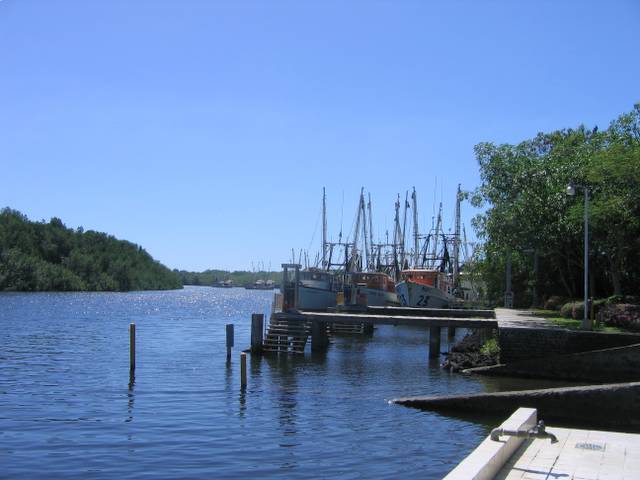
The fuel dock and a fleet of shrimpers tied up just past the club.
Looking the other way, there is Saeta on her mooring.
This is a bonus shot. You should have seen it early, but that´s life. It is a sunset taken at Puerto Escondido (I think).
Volcanos inland from the mangroves along the channel on the way up to the Marina.

Sunday, January 14, 2007

Guatemala to port...

Jan. 14, 2007 - Saturday
Yesterday we finally made our escape from Puerto Madero. PM is a port with little charm, used mostly by fishing boats and local tourism from neighboring Tapachula. However, the people are fascinating. Mostly Mayan stock, they look like history dressed in modern garb. They seem very loyal to their state, Chiapas, a state often seen in our newspapers as a source of political discontent.
We stayed a week after our successful crossing of the Tehuantapec because our genset decided to leak out all it's coolant and then have fuel problems. We had a bad mechanic, me, who finally got it sorted out (mostly). Then, when we tried to check out, we had to deal with an immigration office who decided that they would charge yachts as if they were cruise ships - it cost us $262 to get out of town. We are going to appeal that to a lady set up by ex-president Fox to ensure that yachts are fairly treated. It may be useless, but I'm gonna try.
Now we are passing by Guatemala without stopping. Their port fees are ridiculous. They want to charge $1.50 per foot per night, just to anchor. I don't think so! Our next port is still a day away - Barrillas Marina in El Salvador, reportedly has excellent services for a reasonable price. It is up a river among the mangroves. That means it will probably be buggy. No-see-ums are the worst biting bug I've ever been eaten by. Their bites itch insanely and swell up for days. But at Barrillas, we can leave the boat for some Mayan temple visits and other land excursions.
For now, it feels good to be back at sea. I'm just finishing the dawn watch and pretty soon will be getting some shut-eye. We are getting to be a really good sailing team. Passages don't really tire us out that much - of course, we have had light winds almost all the time. Right now, we have no winds at all. We love our diesel engine!
There is a trio of shearwaters that has decided that we are the event of the day. For more than an hour now, they have been circling the boat and flying by just off the deck, about 2 feet away. They've done this over and over from every imaginable angle.
2PM - later update: the shearwater group kept getting bigger until there were about 20 of them. Finally one of them managed to land on the deck and then another one. The two of them began to bill and coo right under the cabin window and then suddenly, they were going all the way! And then some more of them joined. We became a floating bordello. At one point, there were 9 of them on the foredeck, interrupting each others conjugal bliss. Right now, one amorous couple has managed to hide under the seats of our dinghy and are enjoying some privacy.
You see what passes for entertainment while on passage. Fun is where you find it.
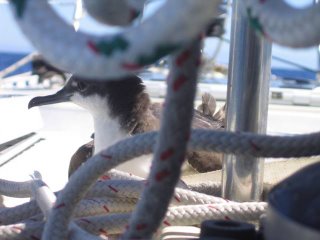
Here is one of the shearwaters. Cute little buggers, eh?

Friday, January 12, 2007

At the end of Mexico

Jan. 12, 2007 Friday - Puerto Madero
The past week has been a bit more challenging than previously. We got into Puerto Madero just fine, but our genset (the source of our battery charging) decided to leak out all of its coolant and then, after it was hot, developed air leaks into the fuel lines as well. That meant that it wouldn't run until we got out all the air. As you may or may not know, as a mechanic I am no better than a C-grade. I can follow a well-written manual, but in this case, the manual had nothing clear to say about bleeding fuel lines. So I had to figure it out by trial and error over the course of about 4 days. During all this time, we had to run our main engine to charge the batteries, which isn't my preference. After a week now, and some helpful emails from the folks who sold us the genset, I have it running again. Someone once said that cruising is fixing things in exotic places. Correct!
On top of all of that, I got a touch of the "turistas". No surprise because I eat everything. We almost made it all the way through Mexico without succumbing, but not quite. It wasn't that bad, but I'd rather be sailing.
We met a great couple, John and Elaine, on Goolka. They are from Canada and are on their way home after a 10 year circumnavigation. They loved Spain and Portugal and loaded us down with handy tips for good marinas, etc. Having just crossed Central America, they had lots of advise for our next leg, too.
There is no wi-fi here, so we are using Sailmail to send these missives. We used to get our radio links through San Luis Obispo, San Diego, or Palo Alto. Now, we find it easier to connect in Corpus Cristi, Daytona, or Rock Hill, SC!

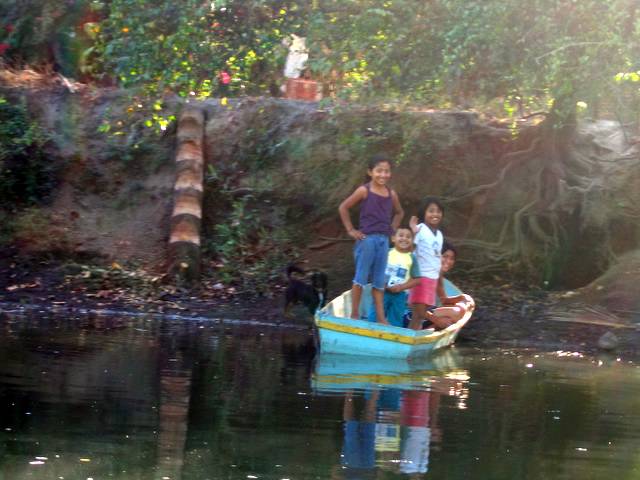
Some cute kids were watching us as we motored our dinghy up a canal to the center of Puerto Madero.
This is a little local market on a street corner.

Thursday, January 04, 2007

In the heart of the Tehuantapec

Jan. 5, 2007 1AM
We are more than half way across the Gulf. Thus far, it has been super-mellow, as promised by weather guru. We left Huatulco at dawn and started down the North side of the Gulf. For a while, we had a current pushing us along 2K faster than we would have gone otherwise. Then, we came to some whirlpools where two currents met. As soon as we passed through that, our favorable current was gone and we were pushing an unfavorable current of 1-1.5K. That means that with the motor and sails pushing us through the water at 7K, we are actually doing 6K. That is the case right now. We are now at the bottom of the Gulf, having passed Salina Cruz this afternoon and are starting a 130 mile leg up the Southern side to Puerto Madera. Even if the strong winds came up now, they would be behind us so we have passed the worst of it.
How bad has it been? Well, let's see. The seas have been flat and although the current is foul, we have almost always had a little wind, so by using the sails with the motor, we managed to hold almost normal cruising speed. There is a full moon and the smell of smoke off the land.
For dinner tonight, we had some of the tuna we caught yesterday - prime ahi! Andi soaked it in soy sauce, rolled it in fresh garlic and then toasted sesame seeds. Then she seared it quickly so that the center was still red and served it with wasabi mayonnaise. Mashed potatoes, a fresh salad, and a tolerable white wine filled out the menu. Nobody suffering here! Not bad for a stretch of ocean that I have been dreading for the last month.
After dinner, I had a hot shower and went to bed. Now I'm on watch and typing this. We are so far ahead of schedule that we may linger in Puerto Madera and maybe try to see some of Chiapas before leaving for Guatemala. Stay tuned and don't forget to write.


Here we see some of the low sandy stretches where Mexico is very narrow and the wind in the Gulf of Mexico funnels through the gap. But not today, gracias a Dios.
You know who this is.

Wednesday, January 03, 2007

Gulf of Tehuantepec!!

1-3-07 Wednesday
In an hour, we will officially be in the dreaded Gulf of Tehantepec where the trade winds of the Caribbean are compressed and flow across the narrowest part of Mexico. But our weather guru promises a weather window of calm winds lasting until Sunday. Yesterday it was blowing 40 knots! Keeping fingers crossed!
We are running way ahead of schedule. We haven't stopped to smell the daisies very much. On the other hand, we've enjoyed driving the boat. We were so concerned about the Tehuantepec and the Papagayo winds along El Salvador that we have pushed to get past them before they get truly wicked (February). So if we have extra time, we'll spend it in Guatamala and Costa Rica.
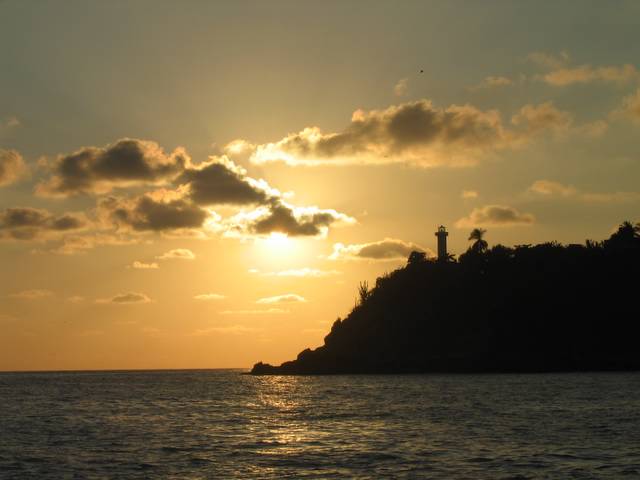
Tonight we'll anchor in Huatulco, the last port before we start the hard part of the gulf crossing. We need to take on lots of fuel in case there is no wind. We carry 135 gallons, so that gives us a range of 800 miles.
Changing topics, yesterday we caught a fine tuna - he was almost round and cut into some dandy steaks. Sashimi was enjoyed for lunch. There is a lot more visible sea life than we have in Calif. Yesterday, we sailed through fleets of turtles - some of them with birds standing on them. A few were even having sex! We gave extra points for spotting mating turtles with a bird on top. Andi is ahead so far. Another difference is that there are no seals or sea lions. They may exist somewhere, but we never have seen any since Cabo.
New topic - vegetables in Mexico are surprisingly good. Asparagus, chard, broccoli are all very green and rich tasting. We didn't expect this, being from Santa Cruz. Mostly they are cheaper except for onions, which are very expensive.
Sorry that we haven't posted more photos. We haven't had good internet connections and I can't send photos via radio (the way you are getting this). We'll make up for it when we get internet.
We can see another sailboat. That is rare. Around harbors, there are always fishing boats, but farther out, we go for days without seeing another boat.
Well, I've been up since 0300, so my compositional skills are flagging. Breakfast is here, so I'll leave it there.

Monday, January 01, 2007

Pictures of Barra Navidad - mostly

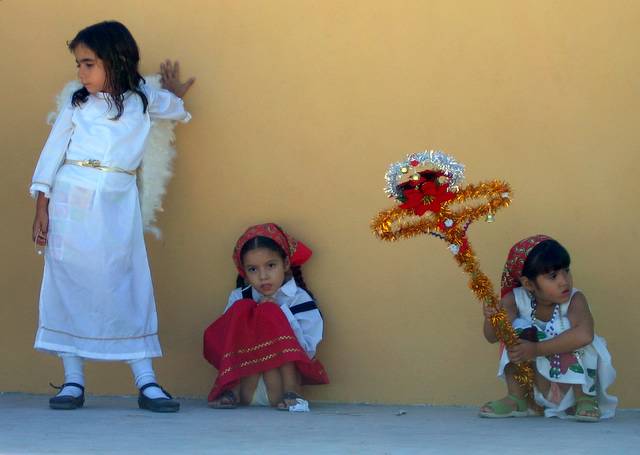
Here are some little girls on their way to a Christmas pageant in Barra de Navidad.
Here is a good sailing picture of the Princess. Sorry they´re all out of order, but thats the way they upload and I don´t have time to move them around.
Here is the main town of Barra as seen from the luxury hotel and marina where we stayed.
And here we were having drinks at the top of the hotel.
Here is Saeta in that fancy marina.
Here is the Anchorage at Maruata on the Michoacan Coast (where we had so many encounters with the Navy).l